

Energy demand in the world is increasing day by day. Meeting the growing demand for energy with limited resources has become quite difficult. Countries are therefore developing activities to produce their own energy and to use their energy resources correctly. As the need for energy keeps growing, the use of efficient products that consume less energy has become increasingly important. The emergence of efficiency classes for electric motors is based on this point.
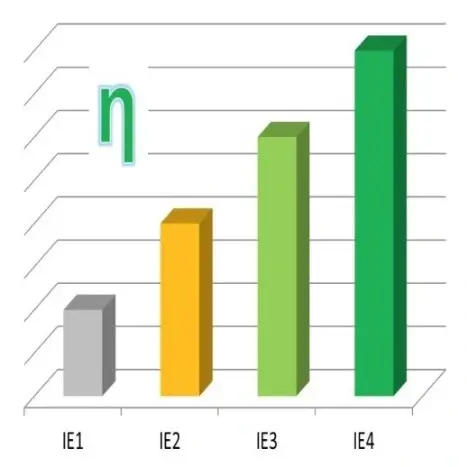
The efficiency classes developed in 2008 under the IEC (International Electrotechnical Commission) 60034-30:2008 standard have continued to the present day. As shown in the chart below, these classes are IE1, IE2, IE3 and IE4. IE4 is the most efficient class, while IE1 is the least efficient.

-
IE1 Class = Standard Motors
-
IE2 Class = High Efficiency Motors
-
IE3 Class = Premium Efficiency Motors
-
IE4 Class = Super Premium Efficiency Motors
Losses in electric motors consist of stator and rotor winding losses, iron losses, and friction and cooling losses, and they are all converted entirely into heat. For the efficiency of a system, using a high-efficiency electric motor alone is not enough; it is also necessary to select an electric motor of the appropriate power and to operate the motor in its highest-efficiency range. Electric motors are designed to deliver their highest efficiency at their rated power, so using an electric motor with more or less power than required causes the motor to run inefficiently. For this reason, attention must be paid to selecting the right motor and using it correctly.
As the efficiency of an electric motor increases, the amount of material used or the cost of the material used increases, and so the cost of the motor, and therefore its price, increases as well. If the investment cost is not a concern, the highest-efficiency motor should always be preferred. However, if the payback of the investment is taken into account, which is the most sensible approach, then the number of hours per day the electric motor will run, the number of days per year it will operate, the unit price of electrical energy and the efficiency advantage that the efficient motor will provide must be taken into consideration. Although the investment may look high at first, considering that the service life of an electric motor is 10-15 years on average, it will pay for itself in a short time and generate substantial cost savings in the long run.